Here is a scene from almost every home.
One partner stays up late fixing the squeaky door. They fill the car, queue the coffee machine for the morning, pay the bill nobody remembered. The other partner lies awake on the far side of the wall, wishing they would stop being useful and just come to bed.
Both of these people are loving someone tonight. Neither of them feels loved.
The 5 love languages are one way to explain that gap. The idea is simple: people give and receive love in different registers, and most of us speak our own by default. We send love in the form we would like to get it, and then feel confused when it does not seem to arrive.
This guide walks through all five languages with examples from real, unglamorous life. It also does something most articles about love languages skip: it tells you honestly where the idea came from and what researchers make of it now. The framework is useful. It is more useful when you know what it is and what it is not.
Where the love languages come from
Gary Chapman published The Five Love Languages in 1992, and the book has barely left bestseller lists since. Chapman was not a scientist running studies. He was a Baptist pastor and marriage counselor in North Carolina who spent years listening to couples in his office.
He kept hearing the same conversation. One person would say some version of "I do so much for this family." The other would say some version of "I never feel loved." Two sincere people, both telling the truth, both baffled.
When Chapman went back through his notes, the complaints seemed to sort into five piles. He gave each pile a name, and the names stuck: words of affirmation, quality time, acts of service, receiving gifts, physical touch.
That origin is worth holding onto. The love languages are a pattern one experienced counselor noticed, shaped by his time, his faith, and the couples who happened to sit across from him. They are not a law of nature. As you will see below, that is not a weakness. It just tells you how to hold the idea: lightly, like a useful map someone sketched, not like a diagnosis.
The 5 love languages, one by one
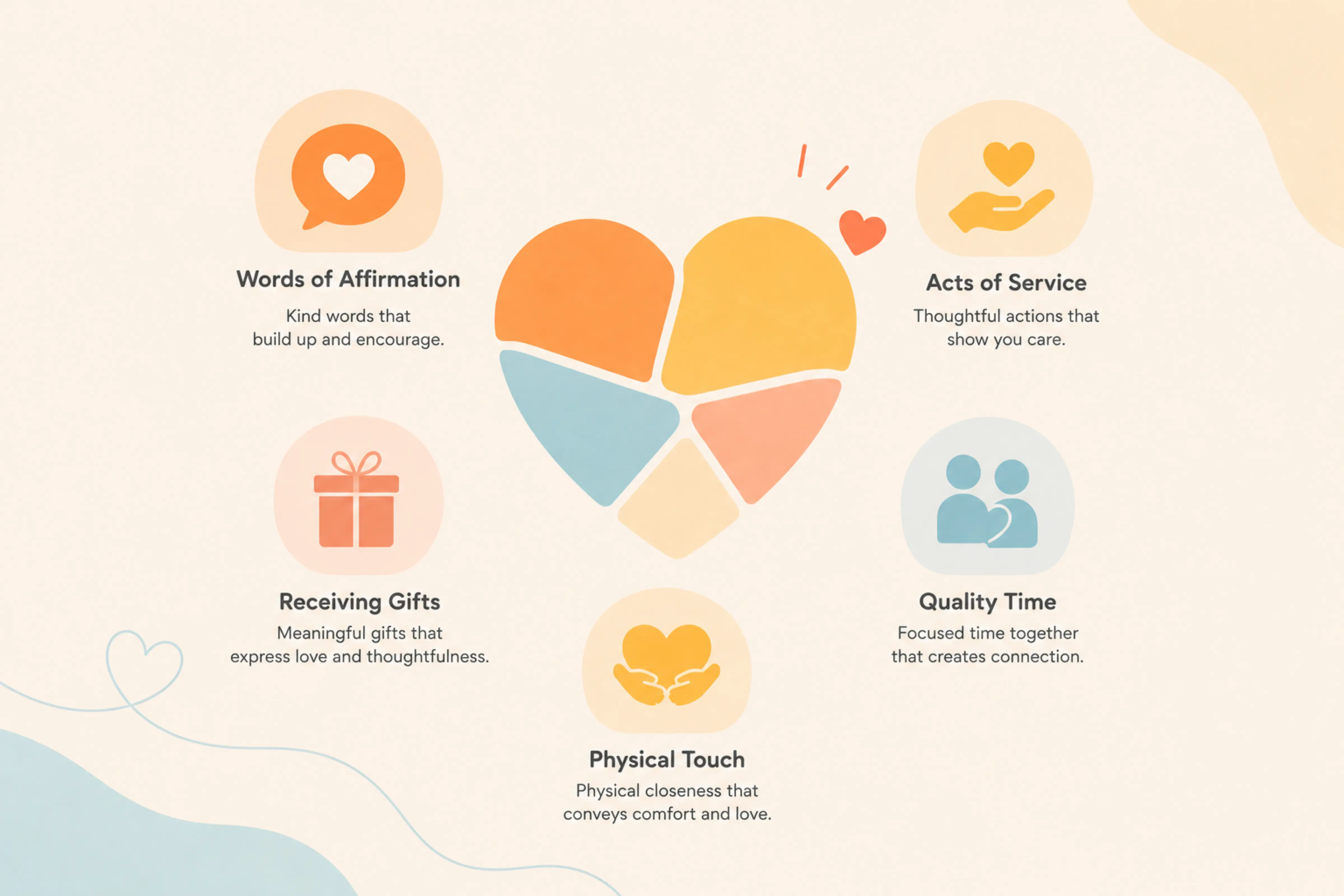
1. Words of affirmation
For some people, love becomes real when it is said. Not flattery, and not a generic "you look nice". A specific sentence that proves someone was paying attention: "I saw how patient you were with your mom on the phone. I don't tell you enough how much I admire that."
If your partner glows for an hour after one good sentence, or quietly wilts when a week passes without one, words are probably their register. The good news is that this language costs nothing and takes seconds. The hard part is remembering that what is obvious in your head is invisible until you say it. We wrote a whole guide on words of affirmation, including what to say when saying things feels awkward.
2. Quality time
This one is widely misread as "spend more hours together". It is not about hours. Two people can share a sofa all evening and never actually meet. Quality time means attention: the phone face down, the show paused, the whole story listened to, including the boring middle part.
People with this language can feel lonely in a busy, functional relationship that looks fine from the outside. If your partner keeps asking "can we just talk?" or remembers tiny details from your early dates, when attention was easy, this is probably them. More on this in our guide to the quality time love language.
3. Acts of service
For acts of service people, "I love you" is a sentence with hands. The prescription picked up without being asked. The tank filled before the trip. The thing you dreaded doing, quietly done.
This language gets dismissed as unromantic, which is unfair. Follow-through is a love letter to the right reader. The catch is that service given in the wrong spirit, with sighing and scorekeeping, stops being love and starts being an invoice. Our guide to acts of service covers the difference.
4. Receiving gifts
The most misunderstood language of the five. It sounds materialistic, and it almost never is. A gift, to someone with this language, is proof of being thought about while absent. The pen grabbed from a waiting room because it was their favorite shade of green. Half the pizza ordered with pineapple, without comment, because that is how they like it.
The price tag is close to irrelevant. What lands is the evidence: you crossed their mind, and you acted on it. We wrote more about why small beats expensive in our guide to the receiving gifts love language.
5. Physical touch
Not primarily what you are thinking. The daily life of this language is a hand on the back while passing in the kitchen, a real hug at the door instead of the distracted one, feet finding each other under the blanket.
For touch people, a day without contact feels like a day spent slightly apart, no matter how kind the words were. And touch is often the first language to fade in a long relationship, which makes it the one most worth tending on purpose. Here is our full guide to the physical touch love language.

Be one of the first couples in the nest
We're quietly making something small and warm for the two of you. Leave your email and you're one of our founding couples: first in when it opens, with a little thank-you we'll keep just for you.
No spam, no newsletter. One good email when it’s ready.
What research actually says
Here is the part most love languages articles leave out.
In 2024, three relationship scientists, led by Emily Impett at the University of Toronto, went looking for evidence behind the framework's central promises. They found surprisingly little. Couples whose languages "match" are not measurably happier than couples whose languages differ. People do not really have one primary language; when you ask them carefully, they want all five in different amounts at different times.
The researchers offered a better metaphor. Love is less like a language you speak and more like a balanced diet. Nobody thrives on compliments alone, and nobody needs zero touch. The proportions just vary, person to person and season to season.
What does predict happy couples is something researchers call responsiveness, which is a clinical word for a homely skill: noticing what your partner actually needs, and acting on it. John Gottman, who has watched couples interact for decades, found something similar in what he calls bids: the dozens of tiny invitations to connect that partners send each day. The couples who last are the ones who turn toward those bids instead of past them.
The framework's real gift is not a label. It is one question: is the love I am sending actually arriving?
So should you throw the love languages out? No. A vocabulary can be useful even when the theory behind it is shaky. "Acts of service" gives a name to something real that couples genuinely miss in each other. The trouble only starts when the labels become boxes: when "I'm just not a words person" becomes a permanent excuse, or when a quiz result gets used as evidence in an argument.
How to use them without turning love into homework
Used well, the love languages are a noticing tool. Here is what that looks like in an ordinary week.
Speak theirs, not yours. This is the whole trick, and it is harder than it sounds. Sending love in your own language feels natural and generous. Sending it in theirs feels slightly foreign, like writing with your other hand. That foreign feeling is usually a sign you are doing it right.
Listen to complaints sideways. Complaints are love languages wearing a disguise. "You never help around here" is rarely about the dishes alone; it points at acts of service. "We never really talk anymore" points at quality time. Instead of defending against the complaint, try translating it.
Ask warmly instead of testing silently. A request made with warmth invites. A demand, or a silent test your partner does not know they are taking, repels. "It would make my whole day if you texted me when you land" works better than three weeks of quiet resentment about texts that never came.
Do not keep score. The point of learning your partner's language is not to invoice them for yours. It is to waste less love in translation, in both directions.
For your next conversation
- "When did you last feel really loved by me? What was I doing?"
- "Which would you miss first: the words, the time, the help, the gifts, or the touch?"
- "What is one small thing I used to do that you wish I still did?"
Notice that none of these questions mention the word "language". You do not need the vocabulary to use the idea. You just need ten curious minutes and a partner whose answers you are willing to take seriously.
That is the quiet truth under the whole framework. Most couples do not stop loving each other. They keep sending love the way they always did, while the other person waits for it in a different doorway. Learning where your person waits is not homework.
It is one of the better ways to spend a Tuesday evening.
What people ask about the love languages
What are the 5 love languages?
Words of affirmation, quality time, acts of service, receiving gifts, and physical touch. The idea is that each person has ways of giving and receiving love that feel most real to them, and that couples often miss each other by speaking their own language instead of their partner's.
Who invented the love languages?
Gary Chapman, who published The Five Love Languages in 1992. He was not a research scientist. He was a Baptist pastor and marriage counselor who noticed that the complaints he heard from couples sorted into five repeating patterns, and he gave each one a name. That origin matters: it is a counselor's observation, not a law of nature, which is exactly how it is most useful.
Are the love languages scientifically proven?
Not in the way the book's popularity suggests. In 2024, relationship scientists reviewed the evidence and found no support for the idea that matching languages makes couples happier. What does hold up is responsiveness: noticing what your partner needs and acting on it. The languages are a helpful vocabulary for that noticing, not a diagnosis.
What is the most common love language?
Surveys often put quality time first, but the spread is wide and it shifts with age and life stage. The more useful question is not which language is most common, but which one your partner would miss first if it went missing.
Can your love language change?
Yes, and it often does. A stressful season can turn anyone into an acts of service person. New parents famously stop wanting flowers and start wanting twenty minutes of sleep. Treat your answers as a photo of this season, not a tattoo.
Be one of the first couples in the nest
Something small for the two of you is on the way. The first couples to join become founding couples: in before anyone else, with a little thank-you saved for when it opens.
No spam, no newsletter. One good email when it’s ready.